The fashion industry is at a crossroads. For decades, it has thrived on speed, volume, and disposability, an equation that has cost the planet dearly. In recent years, sustainability has become a headline topic, yet true impact remains rare. At Many Frocks, we believe sustainability cannot be a tagline or a marketing opportunity. It must be measurable, accountable, verified and rooted in the lived realities of the people who make our clothes.
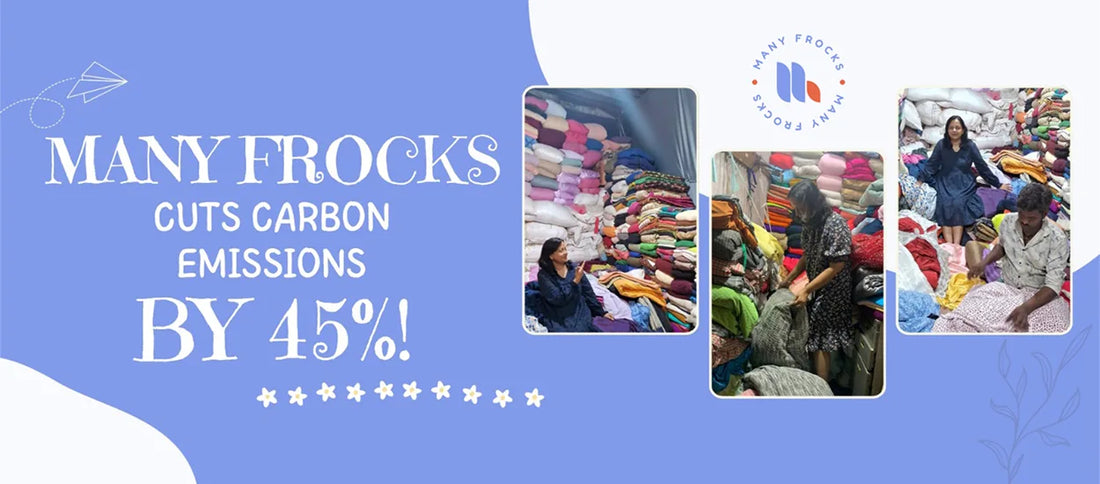
Today, we’re proud to share a milestone that reflects everything we stand for: an independently verified 45% reduction in greenhouse gas emissions from our production process, as certified by Arantree Consulting, Pvt. Ltd., an advisory firm specialising in evidence-backed net-zero and decarbonisation strategies,founded by senior IIT professors. This is not an internal estimate or a theoretical projection. It’s a rigorous, data-backed evaluation of how our products are made and the tangible difference our model creates.
This achievement is more than a statistic. It’s affirmation that sustainable fashion is possible when we rethink the system from the ground up.
A Report Rooted in Science, Not Slogans
The assessment by Arantree Consulting closely examined our materials, processes, sourcing, and manufacturing. Their conclusion was clear: our approach slashes emissions by nearly half compared to conventional production models. In a world where the fashion industry contributes up to 8% of global greenhouse gas emissions this reduction matters. Source: https://www.sia-toolbox.net/sites/default/files/2023-10/ClimateActionTraining_Module1-Why%20Climate%20Action%20Matters.pdf?
But it matters even more because of how we achieved it. Our emission savings aren’t the product of buying offsets or switching to eco-friendly packaging. They come from systemic design choices built into the Many Frocks model choices that challenge the very foundation of how clothes are made.
A Circular, Community-Centered Approach
At Many Frocks, we rethink fashion at three levels: materials, people, and process.
Circular Materials: Giving Fabric a Second Life
Every year, millions of meters of fabric end up in landfills not because they’re unusable, but because they’re surplus, overproduced, or imperfect by industrial standards.
We choose to work with:
- Deadstock fabrics
- Factory offcuts
- End-of-line materials
This slashes the need for new resource extraction, reduces the carbon footprint associated with conventional textile production, and prevents perfectly good fabric from becoming waste. It’s a simple but powerful shift: instead of making new materials, we honor what already exists.
Dignified Livelihoods for Women at the Margins
Sustainability isn’t just environmental, it's social. We work with women from marginalized communities, many of whom lack access to formal employment. Through skill-building, stable salaries/wages, and safe working conditions, we create pathways to financial independence and confidence.
These are not just jobs. They are opportunities for women to rewrite their futures, participate in the economy, and build resilience for their families and communities.
Responsible Design, Thoughtful Production
We adopt a “design responsibly, produce consciously” philosophy. This means:
- Creating versatile, long-lasting garments
- Producing in small batches
- Prioritizing low-impact processes
- Minimizing waste at every stage
The result is fashion that respects both craft and planet pieces made with intention rather than mass manufacture.
Leading With Action, Not Greenwashing
The fashion industry struggles with credibility when it comes to sustainability. Terms like “eco-friendly,” “green,” and “responsible” are often used without transparency or verification. We made a deliberate choice early on to do things differently.
A 45% emissions reduction backed by independent experts from Arantree Consulting is a reflection of that choice.
We do not claim perfection. But we do commit to honesty, measurement, and continuous improvement. Our goal is not just to minimize harm, it is to set a new benchmark for what ethical, climate-conscious fashion can look like in India and beyond.
Why This Matters for the Future of Fashion
The climate crisis demands bold action from every industry. Fashion, with its global reach and massive environmental footprint, has an outsized role to play. But change can only happen when brands embrace responsibility and innovation.
At Many Frocks, we see ourselves not just as a clothing brand, but as part of a larger movement for:
- Circular economy adoption
- Socially inclusive manufacturing
- Transparent sustainability reporting
- Climate-first entrepreneurship
Our work intersects with the vision championed by leaders, innovators, and institutions across India and the world from NITI Aayog, The Do and UNCTAD to social enterprises, climate advocates, and circularity pioneers.
A Future That’s Fashionable and Fair
This milestone is just the beginning. We’re committed to scaling our model, amplifying our impact, and transforming how fashion is perceived and produced.
Every dress, every stitch, every scrap repurposed is part of this journey.
Every woman we support is part of this journey.
Every customer who chooses conscious fashion joins this journey.
Together, we’re proving that sustainability isn’t a trend. It’s a tangible, trackable, transformative act. And at Many Frocks, we’re just getting started.
FAQs
1. How did Many Frocks achieve a 45% reduction in greenhouse gas emissions?
Our emissions reduction comes from structural changes in how we source and produce. By working with deadstock fabrics, factory offcuts, and end-of-line materials and by using small-batch, low-waste production methods we cut the carbon footprint associated with conventional textile manufacturing. This reduction has been independently verified by Arantree Consulting, founded by senior IIT professors.
2. What does “independently verified” mean?
It means the emissions data was evaluated and certified by an external organization with no stake in our operations. Arantree Consulting conducted a scientific, data-driven assessment of our end-to-end processes and confirmed a 45% decrease in greenhouse gas emissions compared to traditional fashion production models.
3. What materials does Many Frocks use?
We primarily use:
- Deadstock fabrics (unused surplus from mills and factories)
- Factory offcuts (high-quality side cut pieces )
- End-of-line fabrics (last remaining meters of premium materials)
These choices prevent textile waste from ending up in landfills and drastically reduce the need for new resource extraction.
4. How is Many Frocks different from fast fashion brands?
Fast fashion relies on mass production, rapid turnover, and resource-heavy supply chains. Many Frocks follow a slow, circular, and conscious model of small batches, thoughtful design, minimized waste, dignified employment, and verified environmental impact.
5. Who makes Many Frocks products?
Our garments are crafted by people from marginalized communities who are trained, fairly compensated, and provided safe working conditions. We invest in their skills, independence, and long-term financial stability.
6. Is sustainable fashion more expensive?
Sustainable pieces may cost more upfront because they reflect fair wages, responsible sourcing, and ethical production not hidden environmental or social costs. At Many Frocks, we work to keep prices accessible without compromising on our values or quality.
7. Do your garments last longer?
Yes. We focus on quality stitching, durable materials, and timeless designs. Our clothing is made to be worn, loved, and re-worn reducing the need for frequent replacement.
8. How does Many Frocks support circular fashion?
We keep materials in use for as long as possible. By reclaiming and upgrading surplus fabrics, designing with intent, and minimizing waste, we participate actively in the circular economy, where nothing valuable goes to waste.


